
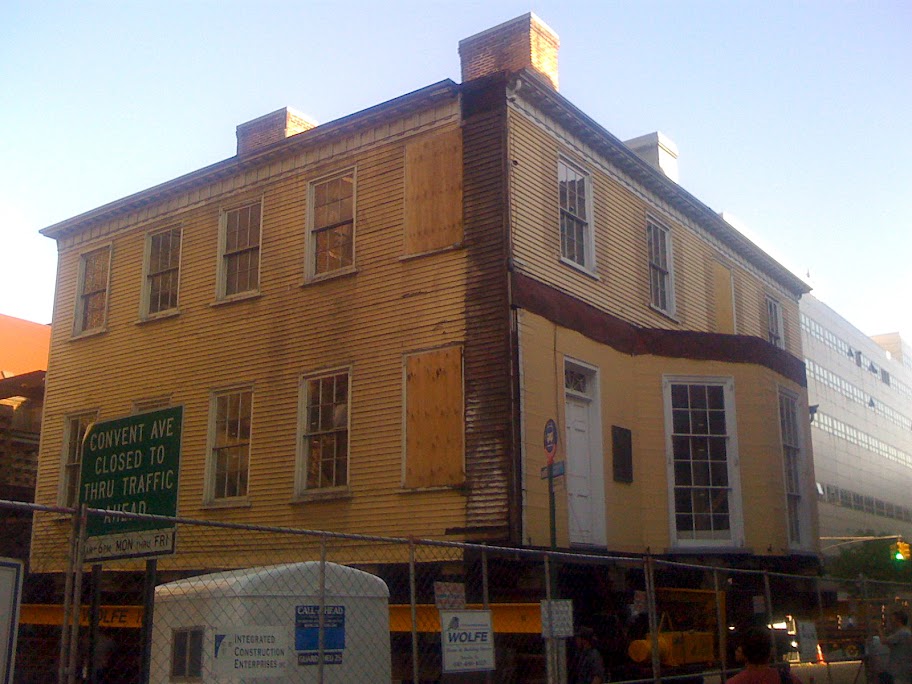
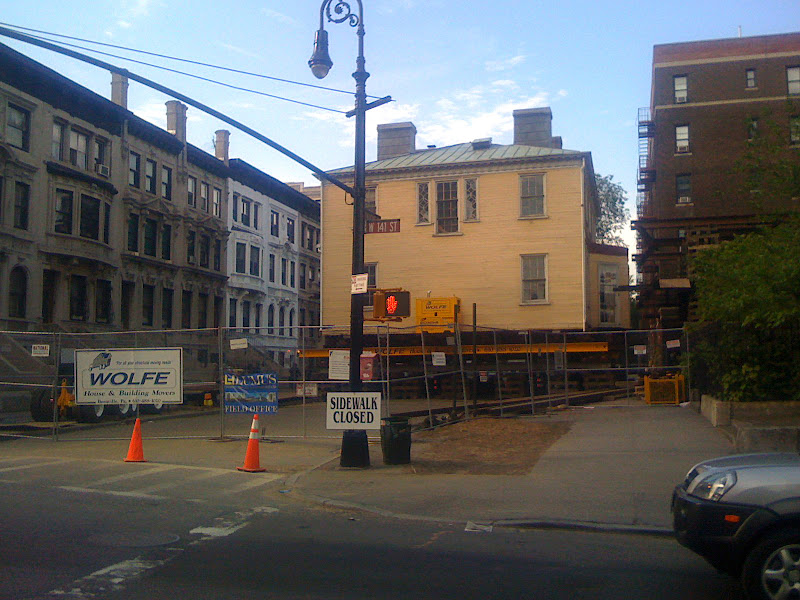
 I couldn't help but be moved by this story, considering how I literally stumbled upon it. A chance lunch date with a friend last week, lead me to show him around my neighborhood in Harlem. On our extended stroll to the restaurant, we passed by a curious construction site. A handsome but rather dilapidated wooden house, sandwiched between a Church and an apartment building, was sitting some 20 odd feet off the ground on what appeared to be an intricate pile of well positioned, oversized jenga blocks!
 It was obvious that the house was carefully, and I should say preciously, being moved. I was intrigued and had to find out more.
Living in the area for over 6 years, I'm ashamed of my lack of knowledge of American history and that I had no idea that such a historic landmark was only a stroll away from where I live and work, for as it turns out, it is the site of The Grange, the country house of Alexander Hamilton, the first Secretary of the Treasury (1789-1795), one of the developers of the Constitution and leader of the Federalist party. He was also the founder of the Bank of New York and The New York Post.
Furthermore, upon my research, I became aware of the controversy behind this move that actually started way back in the early 1900s!
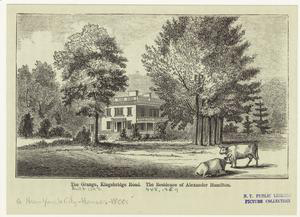
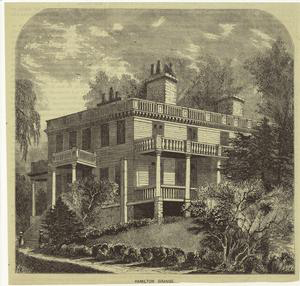 ORIGINAL HOME 1802-1889
In 1798, Hamilton had commissioned architect John McComb Jr. to design his Federal style country home on his 32 acre estate in upper Manhattan. In those days, where I live now, the area was largely farmland. The house was completed in 1802, perched on a woody hilltop, surrounded by wilderness with views from the top floor, of the Hudson River from the front side and the valley of Harlem from the back. Hamilton had only enjoyed his new home for two years, before he was fatally wounded in a duel with his political rival Aaron Burr on July 11, 1804.
The First Move
CURRENT LOCATION 1889-2008
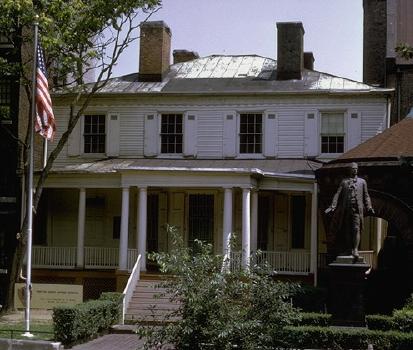
The years after his death were a trying time as Hamilton had left his personal affairs in great disorder. Mrs Hamilton struggled to retain the house, but eventually, parted with it in 1833. For almost a century, the property had been looked after by sympathetic owners until finally, in 1889, when property became too valuable for it to compete with the growing city, Amos Cotting bought the land under the Grange for his row house development, and gave the house to St. Luke's Episcopal Church in exchange for building a church next to his development. This in turn meant moving the house about two blocks away from where it stood, to its current location. Unfortunately, the original porches and piazzas were removed and it was set sideways on a new basement.
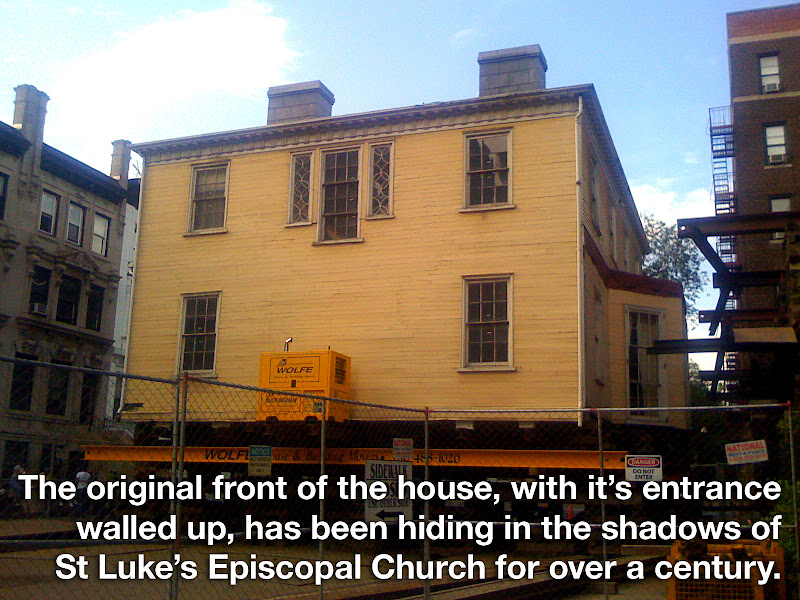 Both the original front entrance, which now faces St. Luke's Church and rear entrance were walled up. A new main entrance was cut in what formerly had been the side wall of the front stair hall, and the original main door was installed there. Another front door was also cut into one of the original rear rooms and the present porch added. At some point, the roof balustrade was also removed. Over the years, the house has sadly resided, quashed between the church and an apartment building with little or no resemblance of its original grandeur.
 The Next Move
NEW LOCATION 2009
Interestingly, discussions to move the house back to a more rural setting began appearing as early as 1901. There is even an article from the New York Times dated March 17, 1912 which not only mentions the desire to restore it and maintain it as a museum with collected personal relics of Hamilton but also its chosen site to be in St Nicholas Park. In the 1950's and 1960's, as the Grange continued to deteriorate, a new push for relocation and restoration emerged and several sites proposed, including the City College campus, Riverside Park, a vacant plot on Amsterdam Avenue and near the Cloisters.
 click map for a larger view
In 1962, the National Park Service became the owner of the house. However, it was only in 1993 that their decision to proceed with the move to the more pastoral setting of St Nicholas Park was made - a plan long opposed by the house's neighbor, St. Luke's Episcopal Church, who claim a historic link with the Grange. More than a decade later, funding was finally allocated and the house's new foundation is being prepared in the park. The missing original entranceway, the front and back porches and other architectural features of the house will be restored.


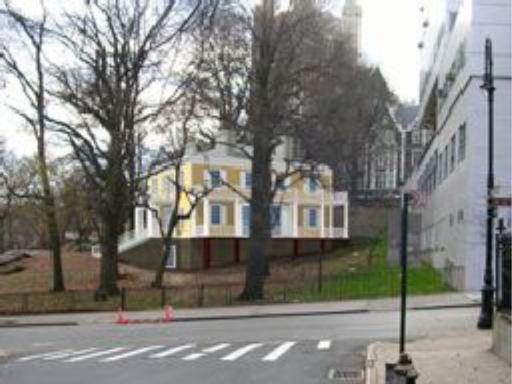 The controversy continued with the question of it's desired orientation. A huge concern to some preservationists who insist that the house's orientation should be positioned as it was originally intended as it would affect not only its exterior appearance but the way natural light would play within it's rooms. But at its new location, perched on a hill-slope in the Park, the idea to rotate it 180º so that the entrance faces the open landscape, would revive the character of Hamilton’s home as a freestanding mansion. Keeping it's original orientation would make the main entrance face the steep ridge from which City College rises and defy common aesthetic sense. Furthermore, regardless of which way it faces, neither the views nor the play of natural light within the house could possibly be replicated on this new site. There may be more accommodating spots in St Nicholas Park, but this chosen corner is more appropriate because it lies within the parameters of Hamilton’s original estate, making a 200-year-old connection between the building and its new setting.
I feel compelled to keep an eye on the Grange in the following months. An easy stroll home from work will take me past this new site and I will continue to record it's move and restoration. So much of its history has already been lost. Considering how it had been butchered for over a century, I personally welcome this move and its new orientation. I only pray that it would be lovingly restored without compromising its old aged beauty. Soon, for the first time in 119 years, the house will occupy a verdant setting, reminiscent of it's original grandeur and one can finally appreciate fully the beauty of the home that Hamilton helped design and once called his "sweet project".

2 comments:
Hi Mark, Loved the story of the American House. I suppose when you live is such a big city like New York a lot can go a miss. Often right under your nose. So to speak. Great Work on it. Thanks
What an interesting story! I had heard about it recently on NY1 they showed a little snippet, not nearly as replete as your reporting on it. I'm now curious as to why our first Secretary of the Treasury left his personal affairs in such disarray. I mean if he could help get the country on its feet and sign the constitution you'd think that it would have been pretty simple to put one's personal affairs in order, right?
Post a Comment